

Talent, AI and agility key to helping SMEs compete globally
The BT Budget Roundtable also explores the role of talent, innovation and government support in driving growth
 Add BT as a preferred source
Jermaine Fok
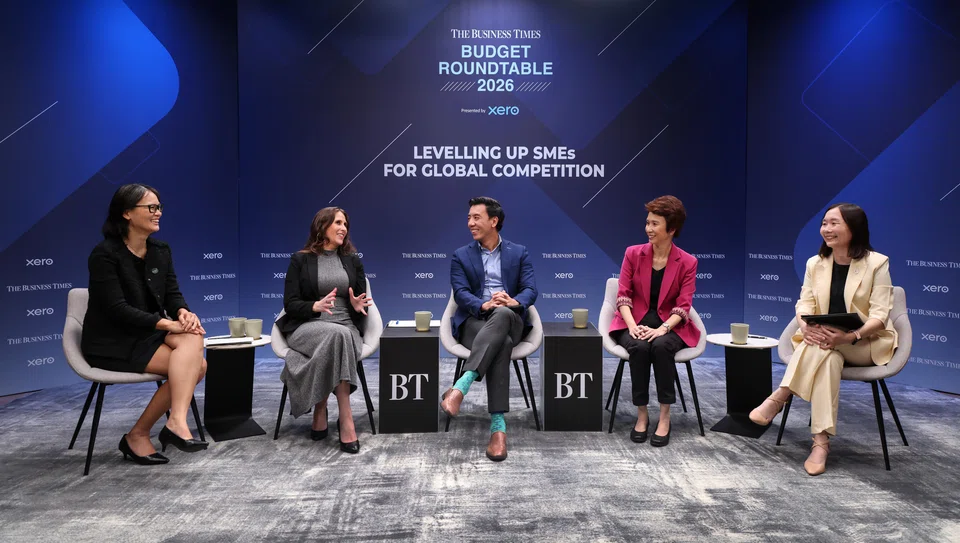
ROUNDTABLE PANELLISTS
- Jeffrey Siow, Acting Minister for Transport and Senior Minister of State for Finance
- Low Yen Ling, Senior Minister of State for Trade and Industry, and Culture, Community and Youth
- Koren Wines, managing director, Xero Asia
- Allison Nam, co-founder and chief commercial officer, Nandina REM
- Moderator: Chen Huifen, editor, The Business Times
When we talk about levelling up SMEs (small and medium-sized enterprises) for global competition, what is the single most critical differentiator? Is it revenue? Is it market access, or is it talent?
Low: I will go with talent. For SMEs, talent is the single most critical differentiator, especially now when SMEs can leverage AI to punch above their weight on the global stage.
Siow: Resilience, to be able to cope with the faster changing world.
Wines: It’s organisational agility – the ability to listen to the market and keep an eye on what’s happening, both in the macro and microeconomics environment and the broader landscape, while being able to pivot in response.
Nam: I pick talent because of how things have been changing and the speed of that change. It is important to have talent that can adapt and think outside the box to create new processes and systems. That’s the key skill set that talent needs to focus on nowadays.
The Economic Strategy Review (ESR) mid-term update notes that growth will be harder to achieve in this new phase of the economy. Given the Budget 2026 focus on AI, transformation and internationalisation, how should SME bosses redefine what a strategic advantage looks like today compared to, say, five years ago?
Siow: The Budget is a long-term plan that was anchored around the ESR’s plan for the next five to 10 years in terms of rebuilding our economy for the future. There are many opportunities within the plan for SMEs.
Number one, we are doubling down on growth sectors that have been successful for us in Singapore.
Navigate Asia in
a new global order
Get the insights delivered to your inbox.
This not only includes the sectors in advanced manufacturing, but also in other areas like biotech and finance – which have traditionally been strong sectors for Singapore where many SMEs support MNCs (multinational corporations) in terms of being part of the ecosystem or supply chain. By doubling down on those growth sectors, we will see opportunities for SMEs.
Number two, we are also going into new sectors such as quantum computing, space tech and sustainable technologies. There are fast-growing new SMEs that are coming into these sectors, doing very exciting new things, and we want to support them to do more.
And finally, AI. We are helping SMEs to build up capabilities in AI, to benefit from AI, to adopt solutions in AI as much as possible, because we know that AI is here and it is going to fundamentally change how the economy and how businesses operate.
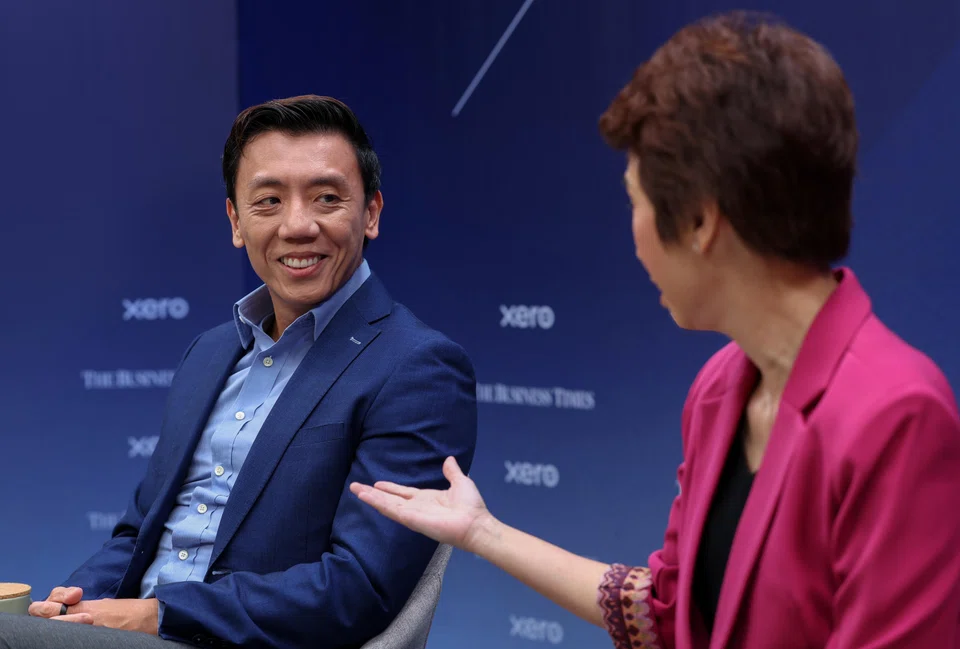
Low: I can offer three areas: the use of technology as well as data capabilities; innovation; and internationalisation.
On the use of technology and data capabilities, there is a really wonderful window of opportunity for SMEs to really bootstrap these capabilities, because they no longer need to spend a lot of money to acquire hardware. For example, AI. We can support SMEs, depending on their digital maturity, to adopt AI.
If SMEs can leverage AI, it can achieve three things. First, AI can assist them in their work by complementing their physical headcount with virtual AI agents. Second, it can automate processes. Third, it can help augment their products and services.
On innovation – in today’s world, you cannot compete just on cost. It’s about differentiating through innovation, and we will continue to support SMEs to invest in product development, branding as well as design, to differentiate themselves.
Koren, if a small company comes to Xero and says they want to go overseas, how can you help?
Wines: Going international is a goal like any other goal, and the only way to achieve it is by having good visibility on your business. Getting onto a tool like Xero is critical so that you have visibility on your financial data.
But it’s also about having agility in jobs beyond core accounting, because that is where you generate your transaction data.
Many people do not realise that Xero is more than just accounting software. We have an app store with 1,500 apps for jobs beyond core accounting. We have had customers with goals – whether to expand overseas, launch a new product line or invest in equipment – who thought they would outgrow Xero and have to move to an enterprise resource planning system at significant cost.
But they discovered apps in the store that helped them achieve their goals without the big-business price tag.
If an SME owner leaves this room and can only change one thing in their business tomorrow morning to be more globally ready by 2027, what should that one thing be?
Nam: I would say talent. SMEs have to be very clear that people are their most valuable resource, but they also need to be very intentional about how they ensure their talent is highly adaptive to evolving circumstances.
Give them the opportunity to work in experimental settings. Give them the flexibility to try, fail and iterate. The last thing is being able to actually listen to how you can plan their career together (with them). Because at the end of the day, keeping talent is also a very big challenge that all of us face.
Wines: Every business owner needs to put systems and tools in place to get visibility on their business so that they can respond to the environment. There is no excuse for paper anymore.
Moving forward, as competitors around you continue to digitalise and embed AI into their businesses, if you don’t keep up, you will not be able to compete. Digitise and adopt AI – your business’ longevity depends on it.
Siow: SMEs should not just aim to survive, they should aim for growth. I know in the current uncertain global climate, many SMEs are focused on getting by. But the key is really to set the bar high and aim to grow.
That opportunity-seeking attitude is what makes the difference. In a world of change, there is also a lot of opportunity, and if you are able to take the risk to try new things, the returns can be significant.
Low: Figure out how you can ring-fence perhaps half a day per month for an AI session with your team. You probably already have operations meetings weekly or fortnightly, but you need to protect time specifically for this.
It is not enough to tell your managers and staff to embrace AI unless you first figure out the pathway. And it’s not enough to tell them to use AI without thinking through what to do with their existing work.
By embracing AI, you can assist, automate and augment your business. And if we can support every SME to have the ambition and the opportunity-seeking attitude to leverage AI and deploy virtual manpower to operate like an MNC, then Singapore can truly be your launch pad.

Decoding Asia newsletter: your guide to navigating Asia in a new global order. Sign up here to get Decoding Asia newsletter. Delivered to your inbox. Free.
Copyright SPH Media. All rights reserved.

