

Social media platforms must verify advertisers’ identities under new Singapore code
Facebook, Instagram and TikTok accounted for about 30% of total scam cases in 2025
 Add BT as a preferred source
[SINGAPORE] Facebook, Instagram and TikTok must soon verify the identities of advertisers on their platforms against government-issued records.
They need to block advertisements from financial services firms not licensed in Singapore, too. This includes advertisers not licensed by the Monetary Authority of Singapore or other relevant authorities in Singapore.
The three social media platforms have to comply with these new requirements by Jan 31, 2027 under a new Code of Practice for Social Media Services for such platforms announced by the police on Aug 18.
Failure to comply is a criminal offence under the Online Criminal Harms Act, which may result in fines of up to S$1 million.
This comes even as Facebook, Instagram and TikTok accounted for about 30 per cent of total scam cases in 2025. In a statement, the police said that these three platforms pose “the highest scam risk to users in Singapore”. Notably, Facebook alone accounted for about 18 per cent of total scam cases here in 2025.
“A key concern on social media platforms is the use of advertisements to target potential victims,” said the police. Noting that these platforms profit from the advertisements published on them, the police added that the platforms must ensure that the advertisements’ content does not result in a crime being carried out.
Facebook, Instagram and TikTok must also prevent advertisements suspected of being linked to scams from being published on their platforms. For instance, they must check if the advertisements have masked URL links that hide what the real URL is or lead to suspicious content.
The social media platforms have to quickly remove suspected scam advertisements that can be accessed here, including those reported by users.
The new Social Media Code builds on existing codes issued earlier for online communication services and for e-commerce services under the Online Criminal Harms Act.
SEE ALSO



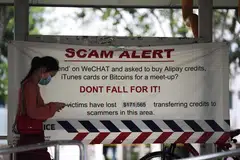
After those two codes came into effect on Jun 26, 2024, scam cases on online services dropped by around 37 per cent in 2025 from 2024, said the police. The reduction shows that upstream safeguards play an important role in making it harder for scammers to target Singapore users, it said.
However, the police pointed to how scammers have adapted their tactics and are exploiting new technologies and features on online platforms, such as messaging applications, online advertisements and video conferencing.
More than four in five Singapore residents, or 84 per cent of them, also reported encountering harmful content online, a recent Ministry of Digital Development and Information survey showed. The most commonly encountered online harmful content they saw was those linked to illegal activity, such as scams.
The police’s Online Criminal Harms Act Office engaged online services on these risks, and later developed new and enhanced Codes of Practice to deal with online harms.
Besides the Social Media Code, the police also issued a new Code of Practice for Online Messaging and Conferencing Services. The police said that the code applies to online messaging and conferencing services that pose the highest risk of scams to users in Singapore.
They are: WhatsApp, Telegram, WeChat, Apple iMessage, Apple FaceTime, Google Message and Google Meet.
By Jan 31, 2027, these services must put in place measures to make it more difficult for unknown contacts to engage users, or alert users to potential scam risk posed by unknown contacts.
For example, the messaging services have to require a user to give consent before the person can be added into a chat group or channel by an unknown contact.
An existing Code of Practice for e-Commerce Services - which applies to Carousell, Facebook Marketplace and Facebook Business Pages - was also updated by the police.
The e-commerce platforms need to have stronger measures in place before allowing logins from new or unrecognised devices. The same advertisement safeguards for the new Social Media Code also apply to e-commerce platforms under the enhanced e-Commerce Code to protect users from being exploited by online scam advertisements. THE STRAITS TIMES
Decoding Asia newsletter: your guide to navigating Asia in a new global order. Sign up here to get Decoding Asia newsletter. Delivered to your inbox. Free.
Share with us your feedback on BT's products and services
TRENDING NOW

When every phone becomes a satellite phone, what happens to Asia’s telcos?

Koh Brothers Eco Engineering faces up to S$57.6 million in potential liabilities from legal disputes

Too little, too late? Manila’s billion-dollar bid to ignite its sputtering EV industry

DayOne secures S$530 million green loan from DBS, OCBC and UOB for Singapore data centre

