‘Don’t interrupt the candidate’: AI is sitting in on your job interviews

Straight to your inbox. Money, career and life hacks to help young adults stay ahead.
[SINGAPORE] Picture this: You are in a face-to-face job interview. Midway through, the hiring manager starts dominating the conversation, speaking at length about the role while you wait for a chance to respond.
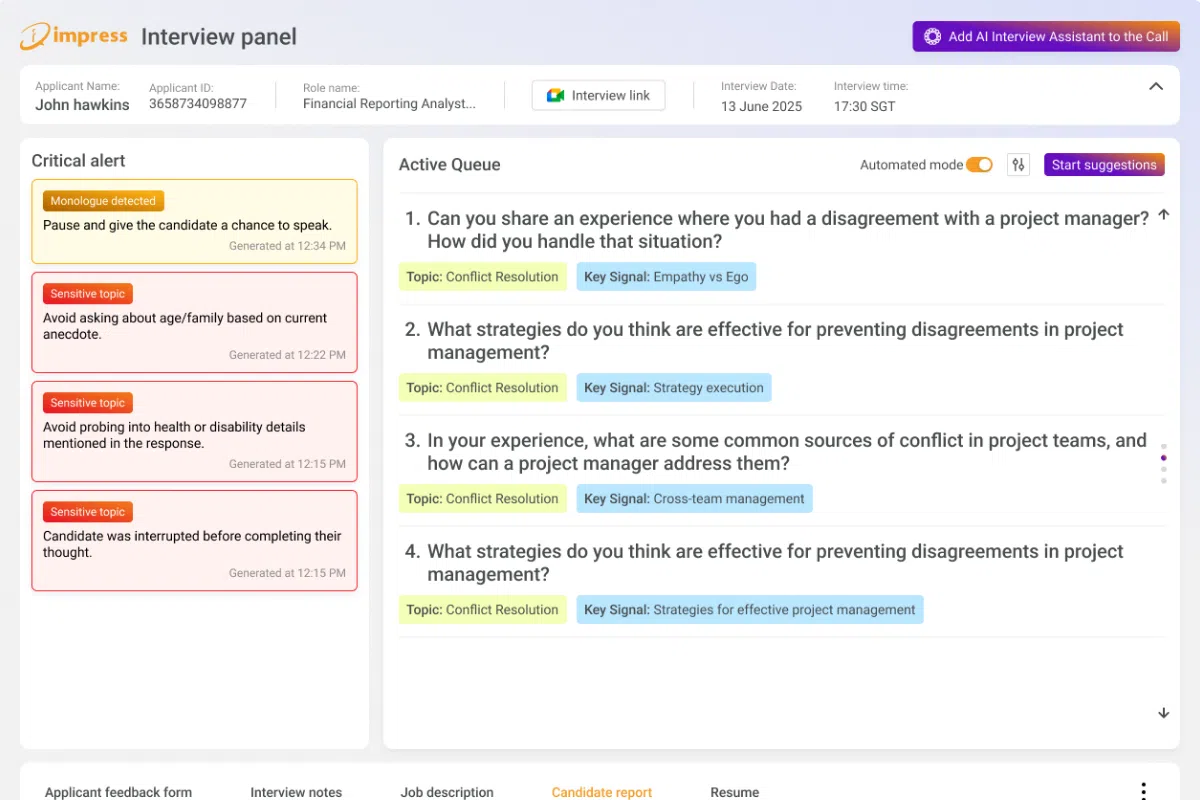
Then a prompt appears on the manager’s laptop: “Monologue detected. Give the candidate a chance to speak.”
Or, after you give a vague answer, another prompt appears: “Ask for a specific example.”
This is the kind of tool impress.ai, a Singapore-headquartered recruitment technology firm, is offering interviewers. Its AI assistant joins a call, listens in on the conversation and generates suggested questions, topics and alerts in real time.
Nearly 90 per cent of companies already use some form of AI for initial candidate screening, according to the World Economic Forum. But a growing number of recruitment technology companies are building tools that go beyond resume screening.
For job seekers, this means AI may no longer be confined to the unseen parts of the hiring process.
At a recent virtual job interview, Amanda (not her real name) found herself not being interviewed by a recruiter or hiring manager, but by a faceless AI.
The questions appeared as text on a screen, and she had to record herself answering them.
What surprised her was that the system appeared to pick up details of what she said and adapted its subsequent questions based on her replies.



“I think my personality or skills shine a bit more when I am able to talk to someone, and I am able to read and judge the overall vibe,” says the 25-year-old, who requested anonymity as she does not want to be identified by employers.
Amanda has done six AI interviews with different companies while applying for internships as an undergrad and, later, for a full-time job. She now works at a tech company.
In some of them, candidates were given a mock round to check their sound, camera angle and appearance before the actual questions began. But in one instance, she did not realise it jumped straight into the real interview.
Thinking she was still in the trial round, she spent the first 15 seconds on camera putting on lipstick and smacking her lips before realising the recording had already started.
“It was quite embarrassing,” she says. She did not get a callback.
Getting pickier
For some time, the conventional wisdom was that you should include as many keywords from the job description as possible – such as “project management”, “stakeholder management” – so that computer systems would rank you as a closer match for the role.
But the technology has become much more sophisticated, says Kevin Gao, chief executive officer and co-founder of Singapore-based start-ups Arros AI and Fuku AI, both hiring tools designed for multinational corporations and small- and medium-sized enterprises respectively.
“Keyword stuffing is a trick from the last generation of hiring tech,” Gao tells Thrive.
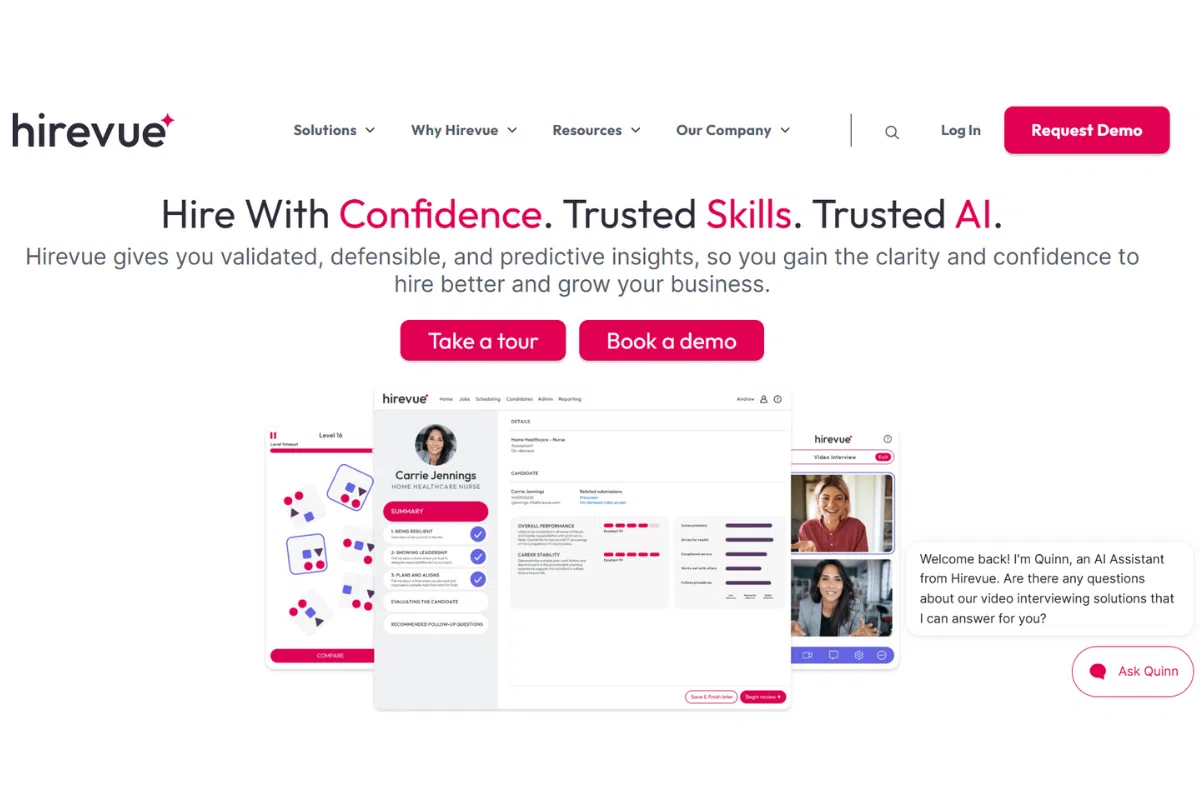
Dr Mike Hudy, chief science officer at Hirevue, says the company’s AI interviewer assesses a candidates’ responses based on a structured rubric that focuses on whether the candidates provide evidence of their capabilities, explain how they approached a situation and describe the actions they took.
“It is not designed simply to count keywords or reward the most polished speaker,” Hudy adds.
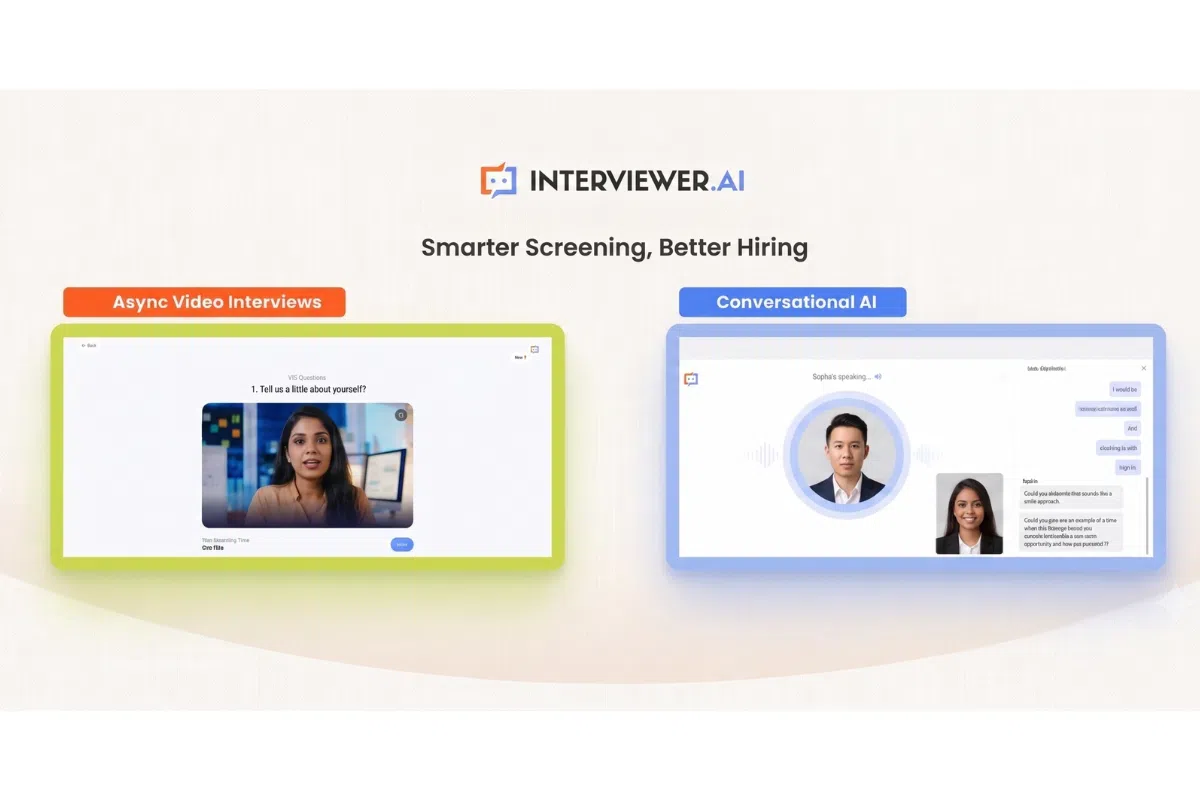
Singapore-based hiring tech firm Interviewer.AI says its system also judges how coherent and articulate a candidate sounds.
In a sign of how quickly employers are responding to candidates using AI to “cheat” in interviews, the company says its own AI is able to flag when a candidate uses AI-generated content, switches browsers, copies and pastes text or has audio anomalies during an interview.
Still, some jobseekers question whether they’re being fairly judged when AI takes over the hiring process.
C Lee, 25, who has sat for two AI interviews, says she finds herself speaking with less emotion and putting in less effort than she would when speaking with a human interviewer.
“The AI interviewer took a while to process my words,” she says. “The awkward pauses made it feel unnatural.”
How to interview with AI
Gao, who worked in executive recruitment for about 15 years before founding Arros and Fuku AI, tells me that one of the biggest mistakes candidates make is treating AI interviews as less important than a human one.
With AI interviews, Gao says the same standards should apply: take the interview in a quiet environment, give complete answers, be specific and put in professional effort.
Terry Toh, career transition strategist and founder of TalkToTerry Coaching, sees AI interviews as another layer of filtering.
“Its job is to shrink the pile, not to find the best person in it, yet,” Toh adds.
Still, he notes that as AI screening tools assess candidates against the same rubrics recruiters use, interviewees should prepare as they normally would but deliver responses more concisely, aiming for 60 to 90 seconds per answer.
Pan Huiyan, founder and leadership coach at Career Big Sis & Co, says: “With AI interviewers, I find there’s a lot more emphasis on the structure, succinctness and sharpness of your responses.”
Candidates should still incorporate relevant keywords from the job description or through company research, but avoid overstuffing to the point where one’s response becomes formulaic, Pan adds.
When I asked the developers of the AI hiring platforms whether there was any way to “game” the system – or more charitably, perform better in an AI interview – their advice was not too different from what career coaches have long said.
Speak clearly, answer directly and provide evidence for your claims.
They mentioned, for instance, the Star framework (situation, task, action, result) or, for shorter or more spontaneous questions, the Prep framework (point, rationale, evidence, point).
Perhaps the rules of interviews may not have changed as much as the interviewer has.
Decoding Asia newsletter: your guide to navigating Asia in a new global order. Sign up here to get Decoding Asia newsletter. Delivered to your inbox. Free.
Copyright SPH Media. All rights reserved.