

AI is running on borrowed money
Risk is rising as big tech firms need to turn to the bond market for staggering sums to finance data centres
 Add BT as a preferred source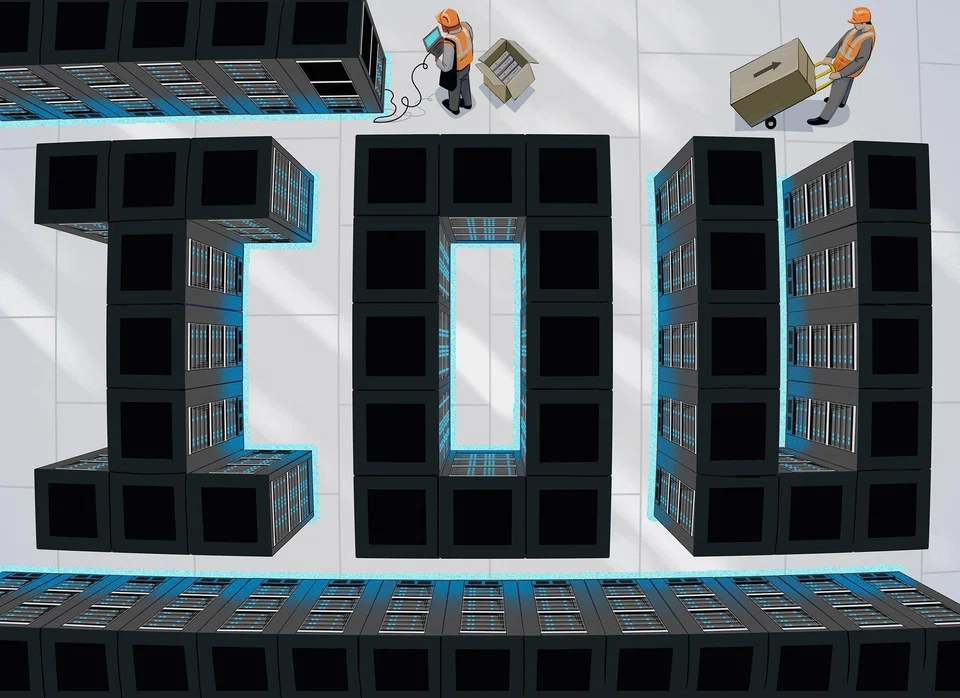
WEALTH from Oracle, the giant tech company founded by Larry Ellison, is enabling him and his son, David, to become media moguls.
Thanks to backing from the elder Ellison’s Oracle billions, the scion has taken control of Paramount and is now engaged in a hotly contested US$111 billion bid to take over Warner Bros Discovery, too. They are trying to build a media behemoth containing two big movie studios, multiple streaming services and news networks CNN and CBS News, all under one enormous corporate roof.
The fight over the Oracle-financed empire has, understandably, captured plenty of headlines.
But what hasn’t received nearly as much attention is another important development, the downgrading of Oracle debt. It now stands just one notch above junk bond status. That happened Jul 9, when S&P Global said that Oracle’s finances had been deteriorating. Oracle has also been hit hard in the stock market, reducing the value of Larry Ellison’s holdings since September by about US$230 billion, according to my calculations based on FactSet data.
What has damaged Oracle’s debt rating and disturbed its finances is the elephant stomping throughout financial markets: colossal spending on artificial intelligence.
Data centres and the other infrastructure for AI involve staggering sums of money. These cascades of AI-driven cash have enriched diverse segments of the stock market, from semiconductor makers to engineering companies to utilities to energy producers.
AI money is bolstering the entire US economy, contributing perhaps 1.1 per cent to the nation’s economic growth, going by JP Morgan Asset Management estimates.
But where’s that money coming from? At this point, a major source is firms like Oracle, which has gone on an immense spending spree on AI data centres, increasingly selling bonds to raise the money.
Oracle is not alone. Alphabet, Microsoft, Amazon and Meta are giant investors in data centres, too. (The industry jargon is “hyperscaler”.)



But their underlying finances are stronger than Oracle’s, and their expenditures have not landed them in the same level of trouble in the markets.
Microsoft, for example, has a triple-A credit rating – better than the US government’s. Whether the company manages to retain that rating after its splurges on AI data centres remains to be seen.
“Microsoft is starting from a much better place, financially, than Oracle is,” Mariya Entina, a portfolio manager for DoubleLine, a money management company, said in an interview. “It’s important to have enough information to be able to differentiate.”
These five companies combined are pouring more than US$800 billion into AI investments this year, and plan to add more than US$1.2 trillion in 2027, according to Morgan Stanley.
To put that in context, as Robert Armstrong of the Financial Times noted, the US military budget request for 2027 is less than that: US$961 billion, according to the Congressional Budget Office.
Few people outside the markets have paid attention to what goes on behind the financial curtain for AI. These big companies are able to categorise the money as an investment – a capital expenditure – and not as an expense. So under current accounting rules, the bulk of the spending has not yet counted against their gaudy earnings.
That is helping to propel the stock market to new heights under rosy assumptions that AI will transform the world and that the companies behind it will be making money.
With the notable exception of Oracle, which has borrowed aggressively for the last couple of years, most of these companies generated so much cash from their main businesses that, until recently, their spending on AI data centres barely weighed on the performance of their stock or on the solidity of their underlying finances.
But this year is turning out to be different.
AI data centres are increasingly running on borrowed money. The problem goes way beyond Oracle.
Hungry for money
The gigantic AI infrastructure expenditures are outpacing growth in profits.
According to Bank of America, total capex for Oracle, Alphabet, Microsoft, Amazon and Meta are exceeding their free cash flow. That’s the money their businesses generate beyond what they need to operate and invest in the future.
The hunger for cash is likely to mount. Bank of America noted that these big tech companies, which formerly operated on relatively little invested capital, are now as capital-intensive as old-line fossil fuel companies such as ExxonMobil and Chevron.
So the tech companies are going to the capital markets, mainly the bond market, which has begun to charge premiums for what it considers to be heightened risk.
Oracle and Amazon bond prices have been hard hit. So have those issued by SpaceX, which is also building AI data centres. Its bonds are rated as investment grade but have been trading at fire-sale prices, like junk bonds.
One problem is that the expected revenue for the data centres isn’t rock-solid. Much of it is linked to AI startups such as OpenAI and Anthropic, which themselves rely on borrowed funds and speculative investments by venture capitalists and private equity funds.
Oracle’s heavy dependence on OpenAI makes it especially vulnerable, S&P Global said.
In a presentation to reporters this month, Savita Subramanian, Bank of America’s chief equity strategist, drew parallels with the dotcom era of the late 1990s and early 2000s. The big “hyperscalers” have far more solid business models than many of the old Internet companies did, she said, but their immense need for borrowing “is a little nerve-wracking”.
If their returns from AI investments don’t pan out, or if their borrowing costs become onerous because of rising rates on debt, these companies may not be in an enviable position. There will be questions about whether their share pricing is “appropriate”, she said, given their “leverage and capital intensity”.
A great winnowing
There are signs that the markets may have started to recoil from some of the more extravagant AI bets. Four of the five big, long-established data centre companies have underperformed the S&P 500 this year. Oracle has been leading the pack downward, with a fall of more than 35 per cent through Friday (Jul 17).
Alphabet, on the other hand, has been ahead of the market, with a stock gain of 10.8 per cent. Its bonds are faring better, too. It may not just be that its Gemini AI model is highly rated.
The company’s finances are more solid than Oracle’s. It has plans to raise more money through bonds – but also through additional equity sales, which would dilute the value of existing stock shares. The stock market has so far shrugged off that move.
SpaceX became a publicly traded company on Jun 8 – and is building big AI data centres with borrowed money.
Its share price has been otherworldly, although the company has no earnings. The consensus estimate is that it will generate some next year – but only enough to give it a price-to-earnings ratio of 182, based on its current share price, according to FactSet.
That number, which measures a stock price against a company’s earnings, is still off the charts: It’s six times the valuation of the average company in the S&P 500.
This week, SpaceX shares for the first time fell below their IPO price, a move that I’ve suggested is warranted.
One day earlier, IBM’s shares lost 25.2 per cent. That was its steepest daily decline since the 1960s, and it was set off by an earnings shortfall that its CEO Arvind Krishna attributed, in part, to the spending under way on AI data centres.
“We did not anticipate the magnitude of the capex reprioritisation,” Krishna wrote in a letter to investors. Other companies spent so much money to build AI foundations, he said, that there wasn’t as much left as expected for software service companies like IBM.
These are early days.
I have no doubt that AI is an important technology. Great fortunes are already being made. But I’m also certain that there will be many losers, as there were in two other episodes of mammoth infrastructure investments in budding technologies: the railroads in the 19th century and the various early internet companies of the dotcom era.
Well-run, diversified and deep-pocketed companies have a better chance of survival in epochs like these than those that take on inordinate risk with their capital investments.
Even so, the future champions may not be any of the early giants.
A great winnowing is coming, and prudent investors will accept that they cannot know in advance who the winners and losers will be. NYTIMES
Decoding Asia newsletter: your guide to navigating Asia in a new global order. Sign up here to get Decoding Asia newsletter. Delivered to your inbox. Free.
Share with us your feedback on BT's products and services
TRENDING NOW

What makes a good job? Feeling that you matter

Faishal Ibrahim resigns over online messages with a female member of the public

When the disruptor gets disrupted: How Chinese open-source AI is eating its own industry

Retail resets: Mall owners reposition shopping centres as Singapore’s consumer landscape evolves

