

Apac family offices turn to trusted managers as hedge fund, alternative allocations grow: Cambridge Associates
Wealth clients are shifting to external managers as they diversify to alternatives

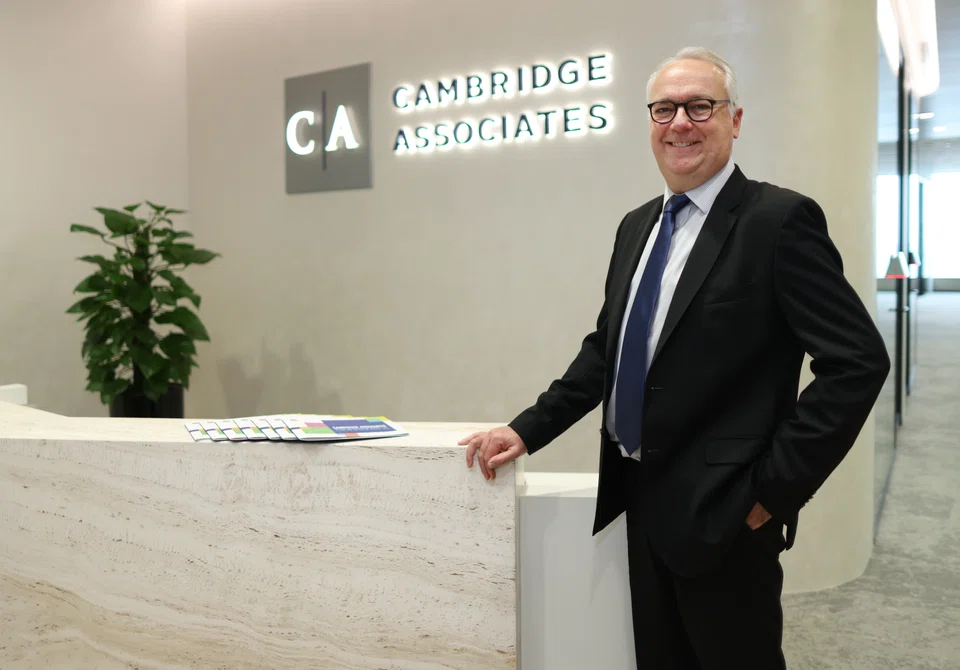
[SINGAPORE] Family offices in the Asia-Pacific are taking in profits from the bull market and putting them to work in alternatives, including hedge funds.
For some clients, hedge fund allocations can sit at 20 to 25 per cent, said Eugene Snyman, regional head of Apac at Cambridge Associates, in an exclusive interview with The Business Times.
“Just thinking off the top of my head of our private clients, generally, very few of them will have less than 10 per cent (allocated to hedge funds),” said Sydney-based Snyman during a visit to Singapore in August.
With market valuations at record highs and equity performance concentrated in artificial intelligence and tech-related thematics, Cambridge Associates is constructive on the hedged opportunity set, particularly in multi-strategy and long-short strategies, he said.
“We’ve seen volatility re-enter the marketplace, and the volatility is driven not only by central banks and monetary policies differing across geographies, but also economic drivers around the world,” he noted.
“And that volatility lends itself very well to hedge fund managers to be able to position their portfolios for those outcomes, which de-risks your pure beta exposure that you have on the long-only side.”
Over the past five years, the firm has seen its Apac assets under management (AUM) and advisement rise by more than 20 per cent to around US$20 billion.
This was driven mainly by private clients, which grew 60 per cent. Discretionary and outsourced chief investment officer services in particular grew 500 per cent to around US$2 billion in the region.
Globally, Cambridge Associates had more than US$600 billion in AUM and advisement, and US$108 billion in discretionary AUM as at Dec 31.
Much of the Apac growth stems from Singapore and Hong Kong, which have been “very important hubs for us from family offices in particular”, Snyman said.
“In Australia and New Zealand, we’ve had very good consistent growth serving private clients, endowments and foundations, and superannuation funds.”
India and South-east Asia have also been strong markets for the firm. It serves South-east Asia from its Singapore hub and India from its Dubai, Singapore and Hong Kong offices.
“We are doing a lot of... strategic work around India. We do identify India as a very important market for us in the years to come... We’re doing a lot of work around more opportunities in India when we don’t have an office presence on the ground,” he said.
Buoyed by its Apac growth, the firm plans to expand its presence in key hubs such as Singapore, Hong Kong, Sydney and Beijing. It has 80 employees in Apac, and plans to hire at least 20 more within the next five years, Snyman said.
Cambridge Associates’ original client base was endowments and foundations, which also continue to grow in the business. While private clients have seen a 60 per cent growth, the firm’s endowments and foundations business has grown 25 per cent in the Apac region over the past five years.
The portfolios that the firm now builds for institutional and private clients are often informed by these long-term pools of capital, which have an almost perpetual investment horizon, Snyman said.
“We spend a lot of time with clients talking about the environment in which we operate, and tilting the portfolio or leaning into areas that we think are offering better value, lower risk downside, but also having exposure to areas where we feel there’s a lot of momentum and returns to be had,” he said.
“And this is a daily, weekly, monthly, quarterly conversation that we are having with our clients, and we do that because we build the bespoke portfolios for our clients. So we don’t have a model portfolio or anything off the shelf that has to try and fit the client’s needs,” he added.
The firm also prides itself on bringing in “best-of-breed investment managers”, he said. This is particularly important in the private markets, where information and data are not as easily accessible to people who are not in the space.
Moreover, private equity and venture capital (VC) internal rates of return (IRR) have been falling over the past decade, which makes general partner selection more important than ever.
The median net IRR for a 2016 vintage VC fund was 12 to 15 per cent, compared with a 0.7 per cent net IRR for a 2022 vintage, indicated data from equity management platform Carta.
“The dispersion between a top-quartile venture manager, and the median, and the bottom-quartile is significant,” Snyman said.
“And so the time spent to identify... and understand why a venture capital manager has the reason to exist and the ability to execute well and generate outsized returns – that is something that we have allocated significant human capital to and knowledge to.”
He added: “A well-executed, well-implemented venture capital programme still continues to generate very strong returns relative to the subset and universe.”
The firm tracks more than 1,500 managers with about 4,500 funds in Apac across asset classes including property, infrastructure, private equity, venture capital, hedge funds, long only, fixed income and private credit.
TRENDING NOW

PSD reviewing paper that alleges civil servants disproportionately bought homes near unannounced MRT stations

CapitaLand Investment’s retrenchments: Mind the downsides of a profitable business laying off staff

In a business takeover, how can landlords in Singapore protect themselves?

How Asia’s next generation is rewriting legacy through entrepreneurship

